

Year 2 at OneThirtyFive: How We Hire BDRs
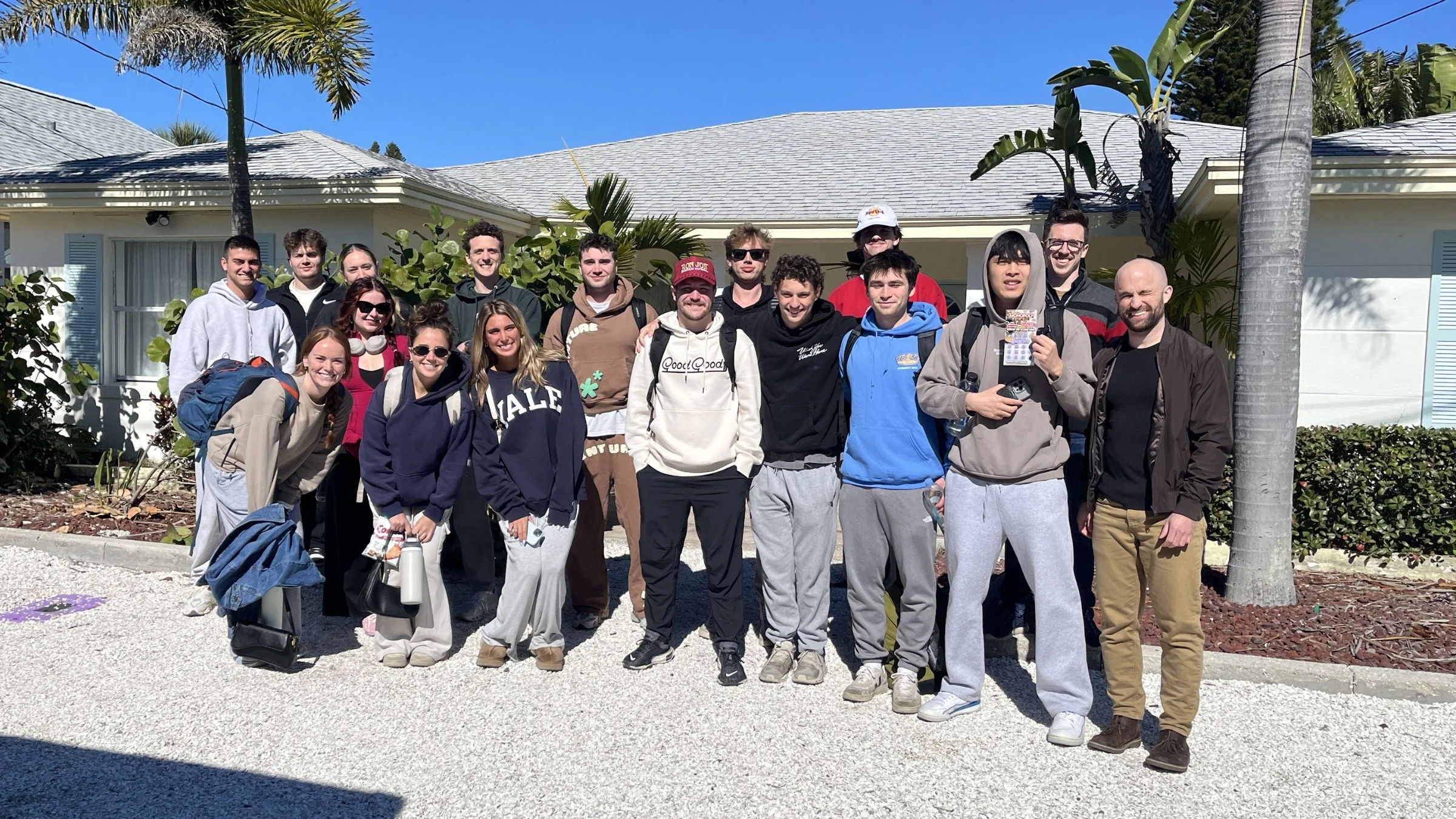
The OneThirtyFive team in Clearwater, Florida (Jan 2026)
Here we are at the finish line of year two for OneThirtyFive.
It was a year of tremendous growth. We scaled our BDR team from 5 full-time employees to 20, hit a million-dollar run rate in October, launched our first product, took the company to a January off-site in Clearwater, and promoted two of our most tenured BDRs. Nate Simon moved into a manager role, and Owain Crute became the first Account Executive of Rep2x.
Since the tools we use to serve clients have largely remained the same, aside from our decision in March to drop email sequencing as a cold outbound process, I decided for this anniversary I’d provide an inside look into our hiring process for our BDRs, who have mostly been fresh out of college with little to no experience. I hope this peek gives other solo founders, startups, and enterprises alike some insight into how to spot the future meeting-generating rockstars of tomorrow.
Want to know how to stand out in our process? Check out our recent post on the Rep2x blog, “How to Stand Out for Entry-Level Sales Roles in 2026”.
Step 0: Sourcing
With the growth of our team over the past year, we saw a bit of a snowball effect. A decent amount of internal referrals turned into new hires at OneThirtyFive.
Aside from that, the bulk of our applications come through LinkedIn or Handshake, which has more of a college career center focus. I wouldn’t say I lean heavily toward one or the other. Both are pretty much at the point where they require a daily payment boost to get any real application volume. After speaking with other hiring leaders, there’s definitely an opportunity for disruption here.
We also tested career fairs pretty heavily over the past two years. We participated in a wide variety of local university career fairs, including more niche, sales-specific ones, but the results have been pretty abysmal. Unless something changes, we’ll probably drop career fairs from the budget moving forward.
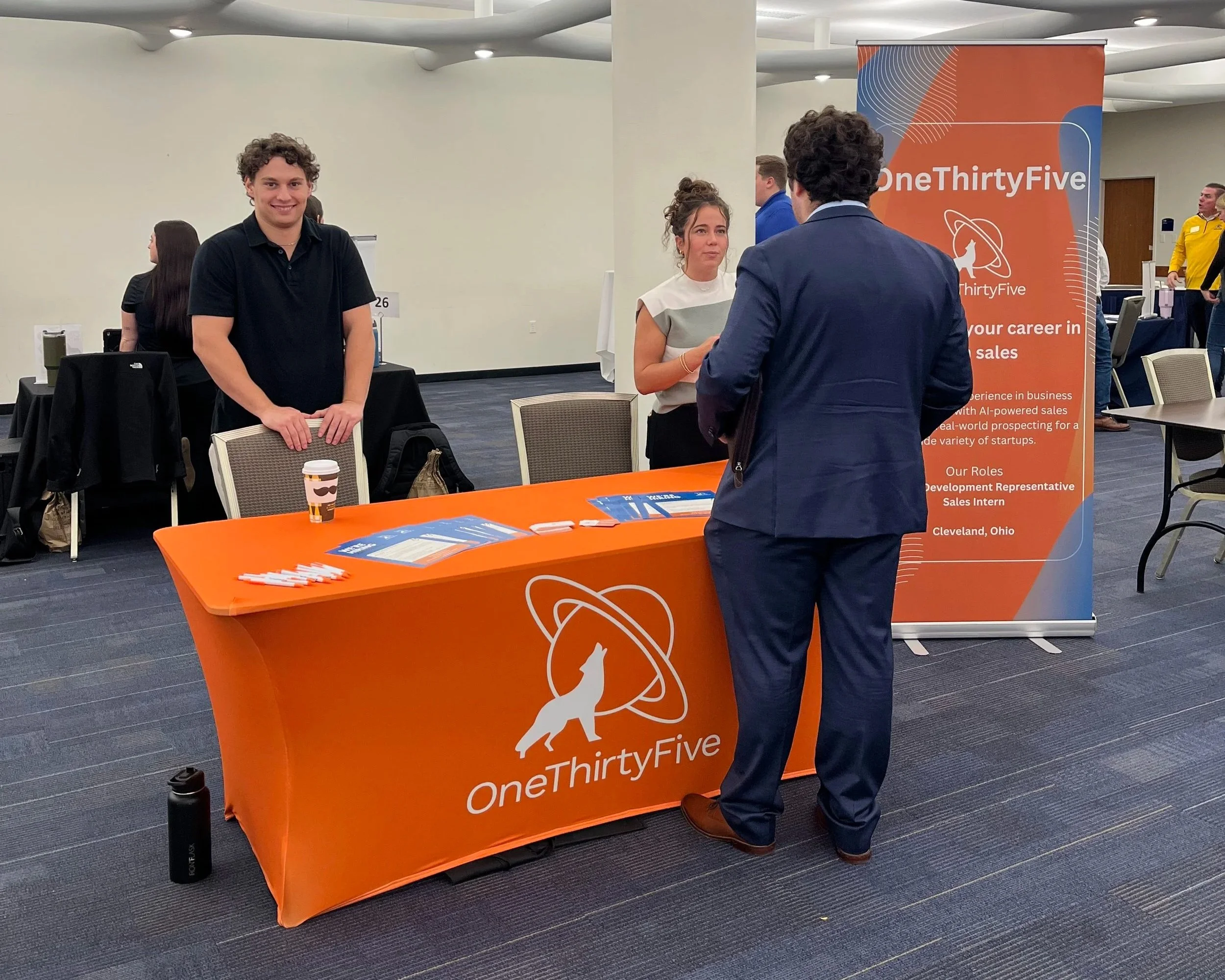
BDRs Jeremy Hy & Annie Orbash at the Kent State Sales & Marketing Career Fair in October ‘25
I’ve recently tasked two employees, Lauren Devin and Lizzie Bruce, with boosting our social media content, specifically on TikTok. While it seems to help show the fun side of the office to people who have already applied, I don’t know that it has resulted in any net-new applications yet.
Step 1: The Voicemail
As a solo founder, I handle our full interview process from start to finish. Because of this, I realized pretty quickly that I was going to waste a ton of time starting with phone screens just to figure out who may or may not be a good fit.
So I implemented our first step: the voicemail.
I don’t even look at resumes. Upon applying, all candidates are provided my work number and asked to leave me a 2-3 minute voicemail highlighting their background and why they applied.
This has worked really well in weeding out legitimate candidates for two reasons.
First, many applicants are just shotgunning out applications and aren’t even serious about the role. This simple task is above and beyond what they’re willing to do for a role they’re not actually interested in.
Second, in my prompt I’m very explicit that because this role involves a heavy amount of cold calling, I want to see how candidates verbally communicate. That alone scares away the people who aren’t about that life.
But that’s also my second objective with the voicemail: how well can you pitch yourself and verbally communicate?
Of the candidates who leave a voicemail, roughly 75% make it to the next step. The rest usually leave very bland or brief voicemails that don’t excite me. If I’m not excited to listen to you talk about yourself, how should I expect you to pitch our clients’ services and offerings?
Step 2: 1:1 Founder Interview
If the voicemail passes the sniff test, it’s on to the video interview.
I send the candidate a link to my calendar and ask that they grab an available time as soon as possible for a 30-minute meeting. If they grab a slot 2 or 3 weeks out, that’s a red flag. There’s not much urgency to keep the process moving.
On the call, I keep things casual. I describe the origins of OneThirtyFive, we dive into their background, and we talk about next steps.
I avoid the generic corporate interview questions like “tell me about a time when you faced adversity” or “how do you deal with disagreements with a peer” since those answers are almost always rehearsed.
Instead, I ask only one question for all candidates:
“You’re fresh in your career. If everything went down a perfect pathway, where is your career in 20 years?”
To avoid giving any future candidates the cheat codes, I’m not going to put what I’m looking for in their answer here. But feel free to DM me on LinkedIn and I’ll be happy to share.
If they show up on time and can speak clearly and confidently, they’ll likely be invited to participate in the third step of our process.
Step 3: Rep2x
Since I’ve described Rep2x in depth elsewhere (see below), I’ll give you the TLDR.
When I started OneThirtyFive in early 2024, ChatGPT had just come out with voice mode. I thought it would be a phenomenal way to put our candidates through a voice-enabled role play with AI to assess how they’d do if they were hired as one of our BDRs.
So every candidate, including our first full-time hire, has gone through the exact same role play scenario: pitching a fictitious staff scheduling software for nursing homes.
One thing that’s been interesting is we’ve had a few candidates who maybe just got by on the voicemail or the 1:1 interview, but then absolutely wowed us on Rep2x. In some cases, their role play performance was strong enough that it essentially earned them an offer. That’s exactly why we use it. Some people are better in the actual motion than they are talking about themselves in an interview.
Upon completion of the 1:1 video interview with me, candidates are given instructions and a 7-day window to complete the role play on our in-house product, Rep2x.
Once they complete the role play, they’re scored on 10 different metrics, provided feedback and recommendations, and ranked against all other candidates who have completed the call. Once it’s complete, I’m alerted to their score. If they receive a passing score, I invite them to the fourth and final step in our process.
Want to check out Rep2x in action? You can schedule a demo with me here.
Step 4: In-Person Interviews
The last step in our process is an in-person interview at OneThirtyFive where candidates sit down for four 10-minute speed interviews with members of our team.
The goal here is to get a wide variety of perspectives from their potential peers and see if anything new is uncovered from those conversations.
Candidates sometimes let their guard down around their peers and will share that they’re not really looking for a sales role, or that they aren’t planning to stay in Cleveland past a few months.
The four OneThirtyFive employees each complete their own candidate assessment form. As long as there are no significant red flags, an offer letter shortly follows.
Closing Thought
Over the past two years, one of the biggest lessons I’ve learned is that hiring great BDRs is not about finding people with the most polished resumes. It’s about finding people who are willing to do uncomfortable things, communicate clearly, move with urgency, take feedback, and compete.
Most importantly, thank you to our team, our clients, and everyone who has supported OneThirtyFive through the first two years. None of this works without the people who bought in early.
We’re still early, and I’m sure this process will keep evolving. But this system has helped us find the people who helped OneThirtyFive get from year one to year two, and I’m excited to see who helps take us through year three.